
Filter by

Generic FPGA Design of Spiking Neuron Model
This paper introduces a new representation of the human brain neuron cell response. Implementation of a single cell model of an excitatory and inhibitory neuron. The architecture is based on mimic the real reaction of the neuron cell. Excitatory and inhibitory are implemented in generic form for all neuron's behavior. The design is tested experimentally using FPGA. The designs have been realized
Design and Implementation of an Optimized Artificial Human Eardrum Model
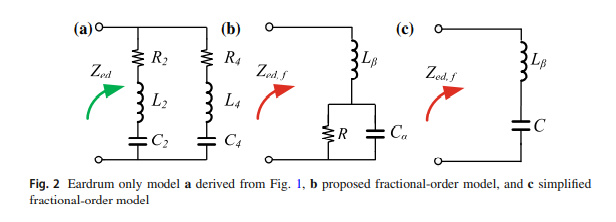
This paper introduces a fractional-order eardrum Type-II model, which is derived using fractional calculus to reduce the number of elements compared to its integer-order counterpart. The proposed fractional-order model parameters are extracted and compared using five meta-heuristic optimization techniques. The CMOS implementation of the model is performed using the Design Kit of the Austria Mikro

Fractional calculus definitions, approximations, and engineering applications
The basic idea behind fractional calculus is that it considers derivatives and integrals of non-integer orders giving extra degrees of freedom and tuning knobs for modeling complex and memory dependent systems with compact descriptions. This paper reviews fractional calculus history, theory, and its applications in electrical engineering. The basic definitions of fractional calculus are presented
Do the Bio-impedance Models Exhibit Pinched Hysteresis?
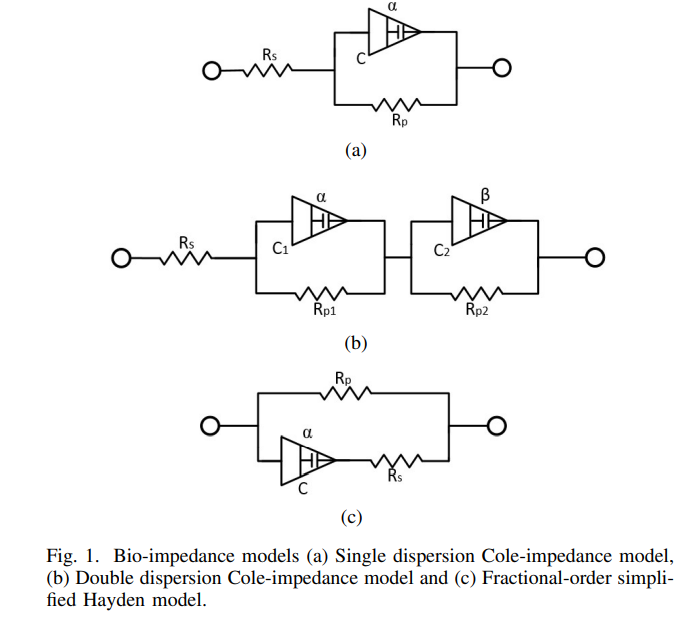
Recently, pinched hysteresis has been found in the electrical modelling of regular plant tissues. Usually, the biological tissues are characterized in the frequency domain using bio-impedance analyzers without investigating the time domain, which would show the pinched hysteresis. In this paper, the current-voltage analysis of some of the widely known electrical bio-impedance models is studied
Single transistor RC-only second-order allpass filters
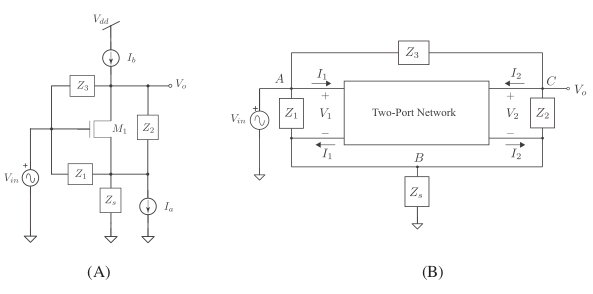
In this letter, all possible single transistor RC-only second-order allpass filters obtainable from a four impedance common-source topology are reported. It is shown that there are only seven such filters with only one of them being a minimum component canonical 2R-2C filter. Two of the found filters are designed and simulated in a 65-nm CMOS process. © 2019 John Wiley & Sons, Ltd.
Generalized α+β-order Filter Based on Single CCII
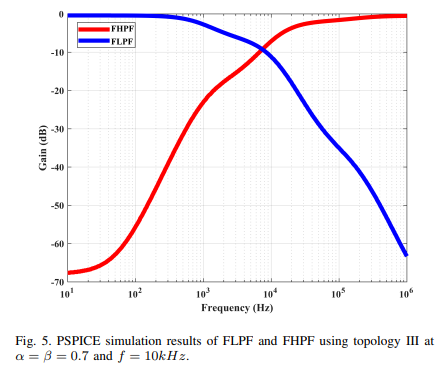
Different generalized filters topologies are proposed in the fractional-order domain. Three voltage-mode topologies and one current-mode topology are used to realize several types of fractional-order filters by applying different admittances combinations. The proposed topologies are designed using a single second-generation current conveyor (CCII-) and two fractional-order capacitors, which add
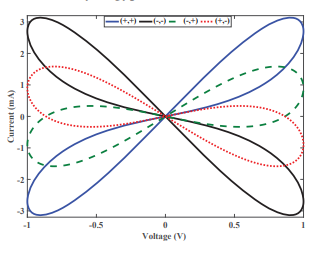
Fractional-order Memristor Emulator with Multiple Pinched Points
The paper proposes voltage-controlled first-and second-order memristor emulators. The emulators are designed using an operational-transconductance amplifier (OTA) and voltage multiplier blocks plus a fractional-order capacitor. The presented second-order emulator provides two pinched points controlled by order of the employed fractional-order capacitor. Numerical and PSPICE simulation results
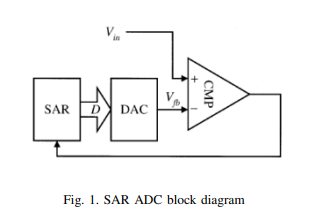
A 26.24uW 9.26-ENOB Dynamic RAM Based SAR ADC for Biomedical Applications
This work introduces a new successive approximation register circuit (SAR) for SAR analog to digital converter (ADC) based on Dynamic Random Access Memory (DRAM) cells. Based on the proposed DRAM based SAR ADC and a differential capacitive DAC, a 10-bit 2V ADC is designed in 0.18um CMOS technology. The proposed SAR is compared to traditional SAR to verify that the proposed SAR decreases the power

Fully balanced LED driving circuit for optogenetics stimulation
Implantable probes with built-in light emitters have a promising potential for a range of applications, in particular optogenetic neural stimulation. However, where soft encapsulation methods are used, lifetime will be a function of the quality of encapsulation and the driving mechanism. We have found that a balanced driving mechanism - whereby the integral voltage on encapsulated contacts, can

Low Power Scalable Ternary Hybrid Full Adder Realization
Multi-level electronic systems offer speed and area simplicity, reducing the complexity of implementation and power dissipation. In this paper, a Hybrid ternary Full Adder (FA) is proposed using Conventional Complementary Metal Oxide Semiconductor (CCMOS), Double Pass-transistor Logic (DPL), and Pass Transistors (PT). The proposed FA is extended up to 64-bits to test scalability. To validate the