
CPW-Fed Bow-Tie Antenna for Ambient RF Energy Harvesting Applications
This paper presents a high-efficiency bow-tie antenna for ambient RF energy harvesting at the 2.4 GHz band. Moreover, a rectifier circuit that converts the AC into DC is proposed. The antenna is fed via a CPW transmission line where a quarter wavelength transformer is inserted to match the slot bow-tie with the 50-ohm transmission line. The structure is simulated using CST software, and results are validated using HFSS. The antenna's directivity, efficiency, and bandwidth are 6.63 dBi, 89.9 %, and 0.946 GHz respectively, as simulated using CST. The antenna is fabricated on a single-layer

IOT-based air quality monitoring system for agriculture
Air quality assessment has been discussed for urban environments with a high degree of industrialization, as they are infested with hazardous chemicals and airborne pollutants. The assessment is carried out by monitoring stations, that basically support limited areas while leaving large geographical areas uncovered. The expansion in the agriculture sector directed us towards air quality assessment on the farms. This is because research has shown that crops can be injured when exposed to high concentrations of various air pollutants, while also affecting farmers' health states. But those air

A Robust Deep Learning Detection Approach for Retinopathy of Prematurity
Retinal retinopathy of prematurity (ROP), an abnormal blood vessel formation, can occur in a baby who was born early or with a low birth weight. It is one of the primary causes of newborn blindness globally. Early detection of ROP is critical for slowing and stopping the progression of ROP-related vision impairment which leads to blindness. ROP is a relatively unknown condition, even among medical professionals. Due to this, the dataset for ROP is infrequently accessible and typically extremely unbalanced in terms of the ratio of negative to positive images and the ratio of each stage of it

Threshold Energy Based LEACH-K Effect on the Accessibility of Wireless Sensor Networks
This paper aims to deliver an exhaustive investigation on the threshold energy parameter's direct impact on the Cluster Head (CH) selection phase in Low-Energy Adaptive Clustering Hierarchy Based on K-Means (LEACH-K) protocols. The most prominent threshold energy selection criterion out of the scarcely available research on the LEACH-K threshold energy parameter is used to simulate the LEACH-K protocol. Simulations are carried out on scaled-up Wireless Sensor Networks (WSNs) in terms of size and number of nodes. An analysis is performed on the life-cycle of the CH selection process, which
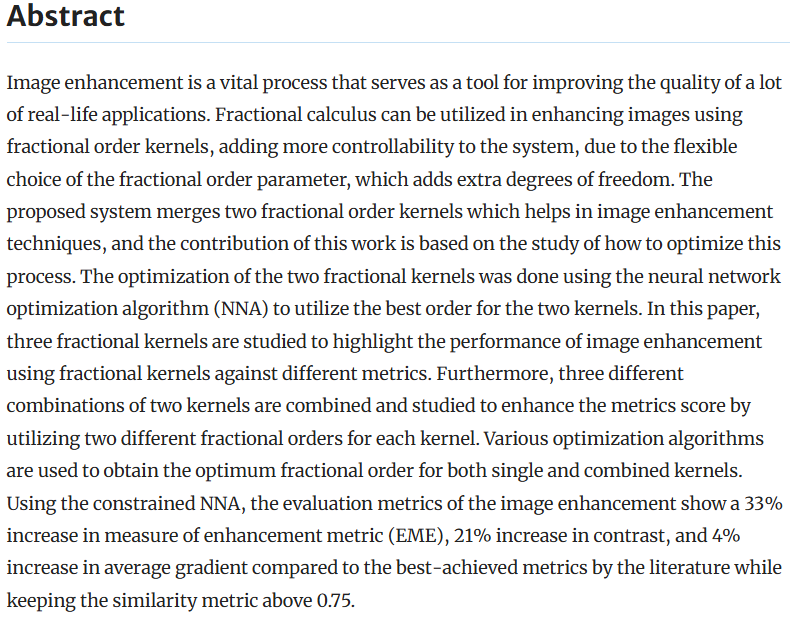
Optimization of Double fractional-order Image Enhancement System
Image enhancement is a vital process that serves as a tool for improving the quality of a lot of real-life applications. Fractional calculus can be utilized in enhancing images using fractional order kernels, adding more controllability to the system, due to the flexible choice of the fractional order parameter, which adds extra degrees of freedom. The proposed system merges two fractional order kernels which helps in image enhancement techniques, and the contribution of this work is based on the study of how to optimize this process. The optimization of the two fractional kernels was done
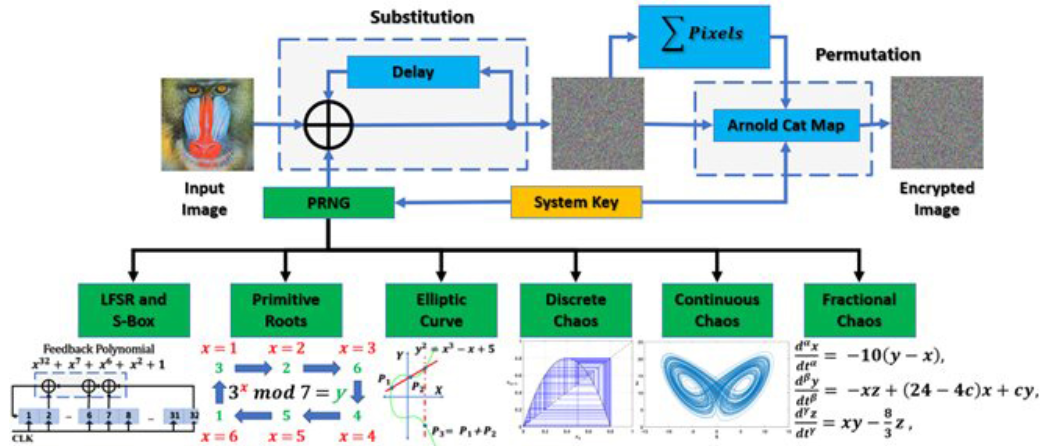
Analysis and Guidelines for Different Designs of Pseudo Random Number Generators
The design of an efficient Pseudo Random Number Generator (PRNG) with good randomness properties is an important research topic because it is a core component in many applications. Based on an extensive study of most PRNGs in the past few decades, this paper categorizes six distinct design scenarios under two primary groups: non-chaotic and chaotic generators. The non-chaotic group comprises Linear Feedback Shift Registers (LFSR) with S-Boxes, primitive roots, and elliptic curves, whereas the chaotic group encompasses discrete, continuous, and fractional-order chaotic generators. This paper
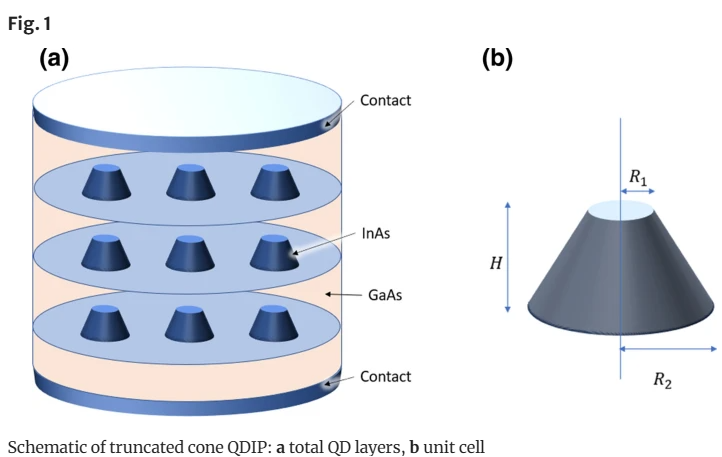
J–V characteristics of dark current in truncated conical quantum dot infrared photodetectors (QDIPs)
Quantum Dot Infrared Photodetector (QDIP) is one of the promising candidates for infrared photodetection due to its controllable heterojunction bandgap and sensitivity to normal incident radiation. It is expected to be superior to infrared photodetectors of mature technologies such as Mercury Cadmium Telluride (HgCdTe) or a quantum well infrared photodetector. In the presented paper, we have developed a theoretical model for the dark current in truncated conical QDIP as the truncated conical shaped QD structure is more appropriate to describe the fabricated dots. The dark current model is
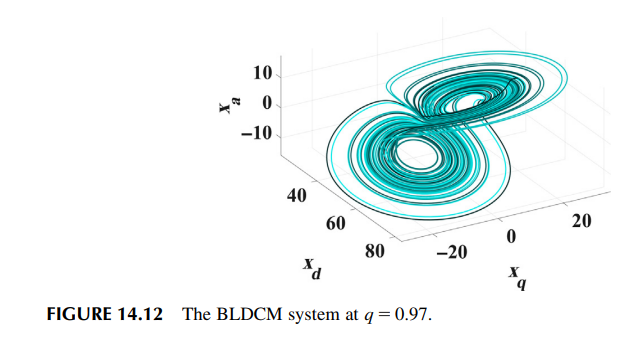
Applications of continuous-time fractional order chaotic systems
The study of nonlinear systems and chaos is of great importance to science and engineering mainly because real systems are inherently nonlinear and linearization is only valid near the operating point. The interest in chaos was increased when Lorenz accidentally discovered the sensitivity to initial condition during his simulation work on weather prediction. When a nonlinear system is exhibiting deterministic chaos, it is very difficult to predict its response under external disturbances. This behavior is a double-edged weapon. From a control and synchronization point of view, this proposes a
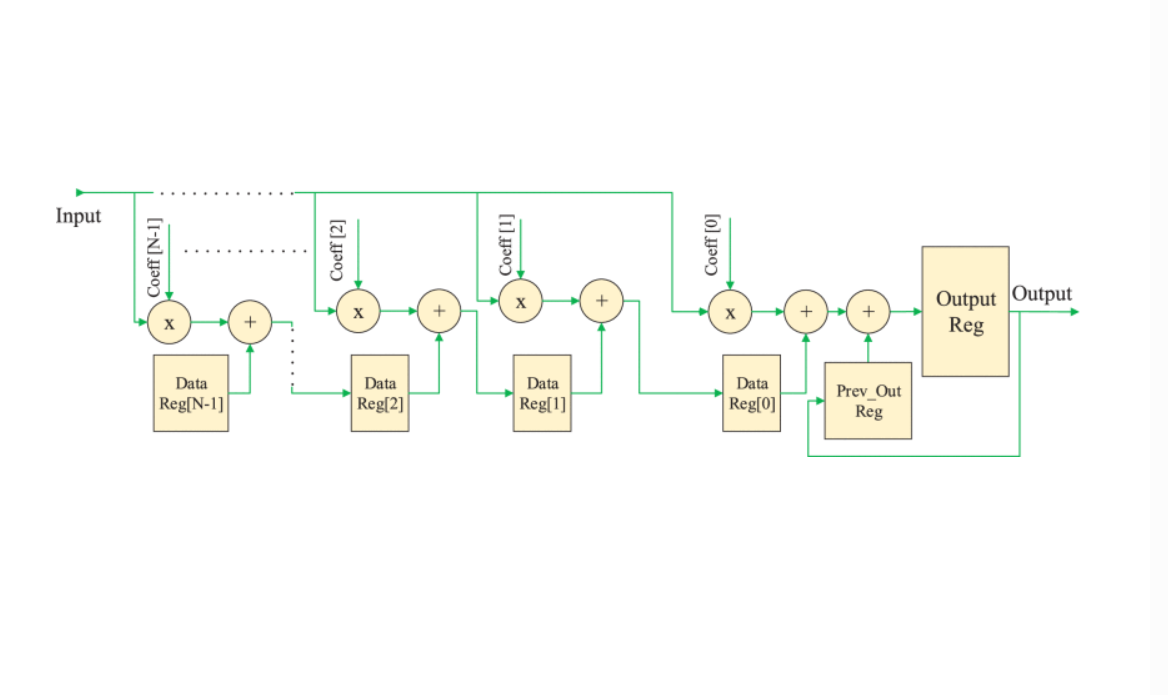
Hardware Accelerator of Fractional-Order Operator Based on Phase Optimized Filters With Applications
Hardware accelerators outperform CPUs in terms of performance by parallelizing the algorithm architecture and using the device’s programmable resources. FPGA is a type of hardware accelerator that excels not only in performance but also in energy efficiency. So, it provides a suitable platform for implementing complicated fractional-order systems. This paper proposes a novel phase-based optimization method to implement fractional operators using FIR and IIR filters. We also compare five fractional operator implementation methods on FPGA regarding resource utilization, execution time, power

Double Visual Cryptography Using Generalized Tent Map, Rotation, and Image Filtering
This paper introduces a Multi-Visual Cryptography (MVC) system for sharing two color images, where the secrets can be revealed with low computation power using all the shares. The system uses the generalized Tent map as a source of randomness to generate any number of random shares. More specifically, (n-1) random shares are generated, and then, the nth share is calculated from the random shares and the secrets using rotations of the shares. In recovery, rotation of the last share recovers the two images based on the angle of rotation. Half the number of pixels is recovered for each secret