
Communication—convolution-based estimation of supercapacitor parameters under periodic voltage excitations
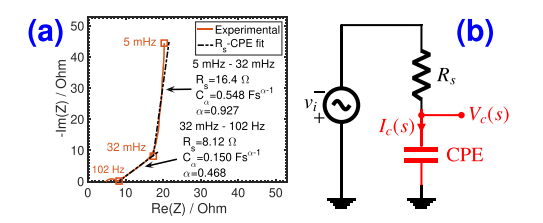
Supercapacitors are typically used in applications requiring frequent and continuous charging/discharging cycles, but most of the models available in the literature are designed to predict their behavior for a single sequence. In this letter, we show first that the electrical response and metrics of supercapacitors under periodic voltage excitations can generally be obtained using Fourier series analysis and convolution operations of functions derived based on any suitable impedance model. We verified our analysis procedure with simulations using particle swarm optimization, and experiments
Communication-The Ragone Plot of Supercapacitors under Different Loading Conditions
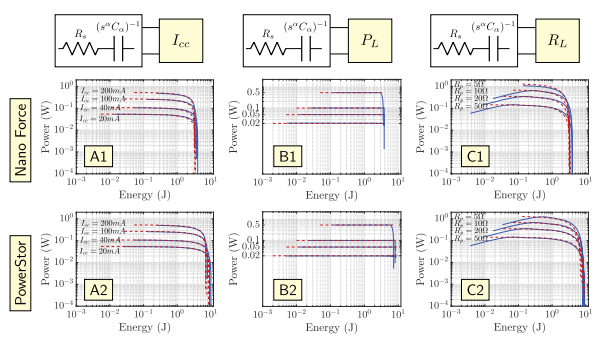
The power-energy performance of supercapacitors is usually visualized by the Ragone plot of (gravimetric or volumetric) energy density vs power density. The energy is commonly computed from E = CV2/2, and the power from P = E/Δt, which assume RCbased models. In this study, we investigate the energy-power profiles of two commercial supercapacitors discharged with three different types of loads: (i) constant current, (ii) constant power, and (iii) constant resistive load. The energy is computed as per the definition from the time-integral of its instantaneous power, i.e. E(t) = ò p(t)dt with p(t
Stochastic modeling of 2D photonic crystals
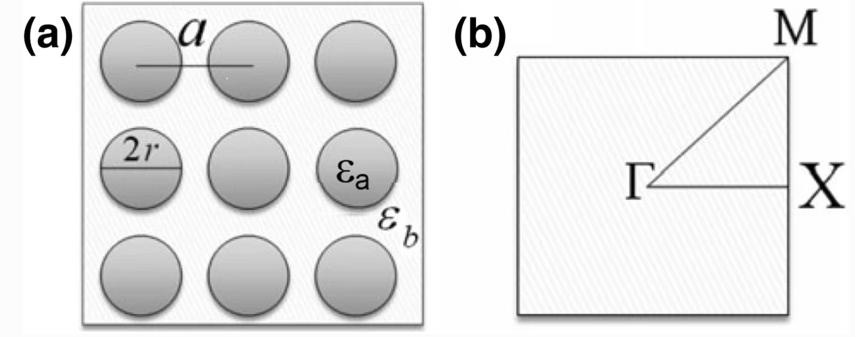
Due to the fabrication processes, inaccurate manufacturing of the photonic crystals (PCs) might occur which affect their performance. In this paper, we examine the effects of tolerance variations of the radii of the rods and the permittivity of the material of the two-dimensional PCs on their performance. The presented stochastic analysis relies on plane wave expansion method and Mote Carlo simulations. We focus on two structures, namely Si-Rods PCs and Air-Holes PCs. Numerical results show—for both structures—that uncertainties in the dimensions of the PCs have higher impact on its photonic
Improved memristor-based relaxation oscillator
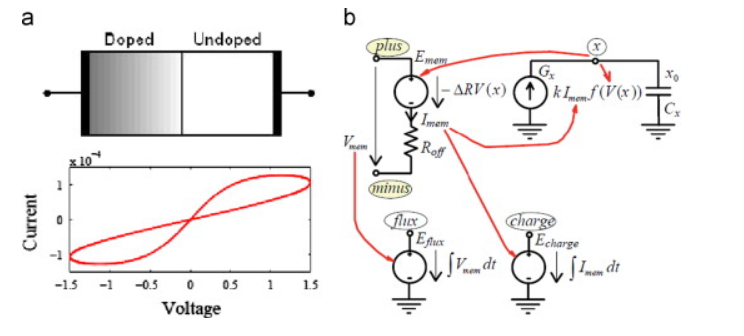
This paper presents an improved memristor-based relaxation oscillator which offers higher frequency and wider tunning range than the existing reactance-less oscillators. It also has the capability of operating on two positive supplies or alternatively a positive and negative supply. Furthermore, it has the advantage that it can be fully integrated on-chip providing an area-efficient solution. On the other hand, The oscillation concept is discussed then a complete mathematical analysis of the proposed oscillator is introduced. Furthermore, the power consumption of the new relaxation circuit is