
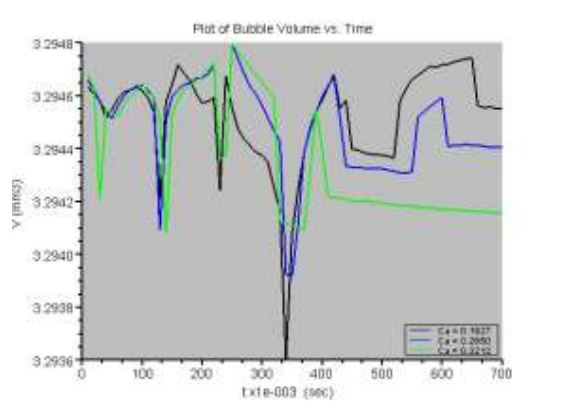
Two-dimensional front-tracking model for film evaporation
To understand the physical process involved in film evaporation, a new numerical model is created using coupled quadratic finite element formulation of the conservation equations. The heat transport equation is solved in the three different phases (solid, liquid and vapor) while the Navier-Stokes equation are solved in the two fluids. The gradient discontinuity at the liquid vapor interface provides local value of the evaporative flux density that is directly linked to the interface velocity jump through mass conservation principle and used as boundary condition for two fluid flow computations
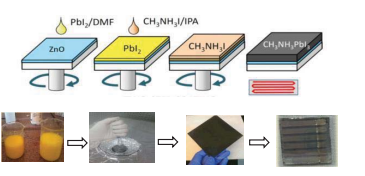
Interfacial modification of perovskite solar cell using zno electron injection layer with pdms as antireflective coating
Recently, perovskite solar cells (PSCs) exhibits tremendous power conversion efficiency and has shown enhanced figures of merit being secured regarding cell stability. In this paper, perovskite solar cell with Zno electron injection layer is presented. The humidity degradation of the perovskite active layer and the efficiency of the cell is observed under several conditions. Using ZnO as a planner electron injection layer (EIL) instead of TiO2, the efficiency of the device significantly improved, showing low-resistance shunting pathways. Also, polydimethylsiloxane (PDMS) has been used as a
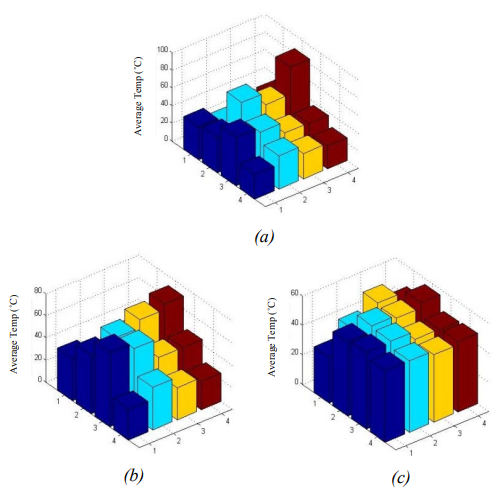
Temperature-aware adaptive task-mapping targeting uniform thermal distribution in MPSoC platforms
As on-chip integration increases, the thermal distribution becomes spatially non-uniform and varies based on the power dissipation. In this paper, we introduce a temperature-aware task-mapping algorithm to prevent hotspots and achieve a highly uniform thermal distribution using adaptive multi-threshold values. The algorithm monitors the temperature of the cores, swaps tasks when the temperature of the core is relatively higher than the average temperature of the chip. Cores are switched off if they exceed an absolute maximum temperature. Using this algorithm, reliability is enhanced by
Commercial supercapacitor parameter estimation from step voltage excitation
Supercapacitors are crucial elements in advanced industrial electronic systems particularly when supplied from renewable energy sources. Here, we derive expressions for the current, power, and stored energy in a supercapacitor excited with a step voltage signal. Although, it is not common practice to charge supercapacitors using a step voltage, these devices are sometimes used in switching-type applications where they are subject to this type of signal. We validate the derived mathematical expression of the current via experiments on four different commercial devices. By fitting the measured
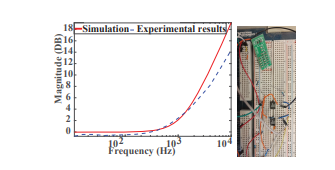
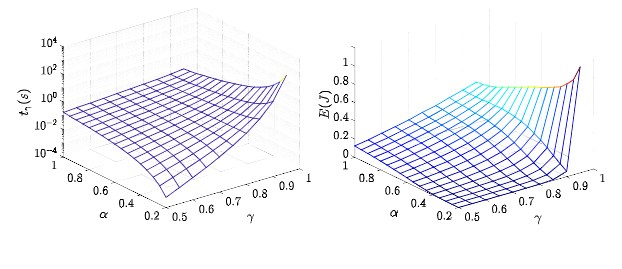
Frational Order Inverse Filters Based on CCII Family
This paper proposes two generalized topologies of fractional order inverse filters (FOIF). All possible realizations of each topology are investigated using the second generation current conveyor (CCII) family. Inverse fractional highpass (IFHPF), inverse fractional bandpass (IFBPF), and inverse fractional lowpass (IFLPF) filters are realized using the same topology based on the generalized admittances. Numerical and P-Spice simulation results are presented for selected cases to approve the theoretical findings. The fractional order parameters increase the design flexibility and
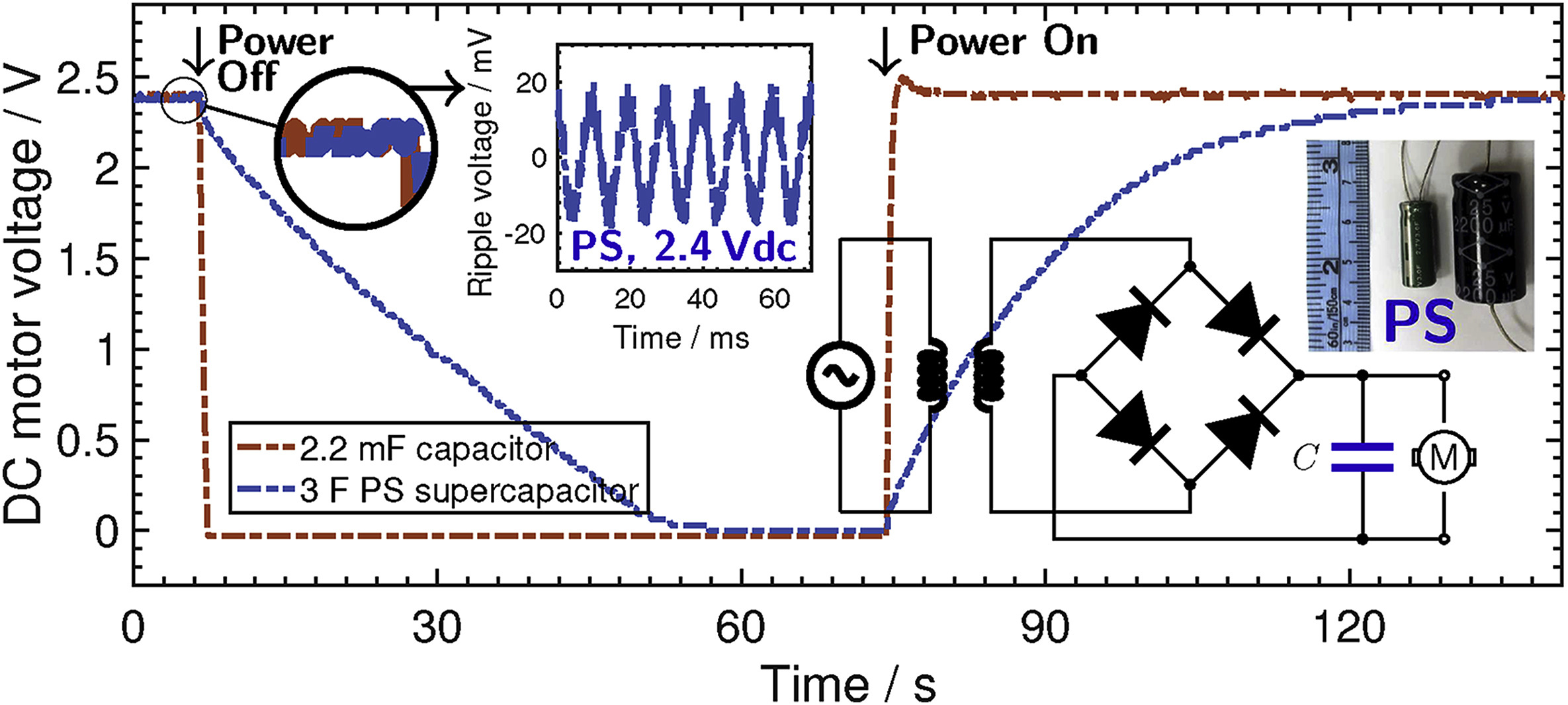
Capacitive behavior and stored energy in supercapacitors at power line frequencies
Supercapacitors are commonly viewed and mainly employed as dc electrical energy storage devices. Their behavior at far-from-dc is usually overlooked and not well explored for potential applications. In this work, we investigate analytically and experimentally the performance of supercapacitor at high frequencies, including the 50 Hz/60 Hz power line frequencies. The variation of effective capacitance, power and energy with frequency are analyzed using a fractional-order model consisting of a series resistance and a constant phase element for both pure sinusoidal and full-wave rectified voltage
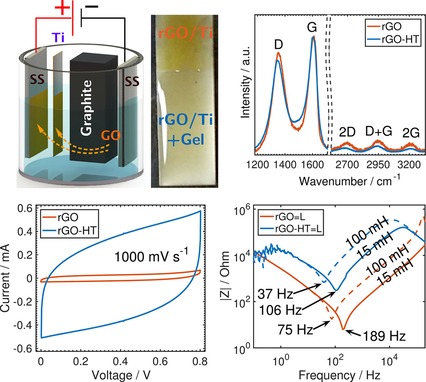
All-Solid-State Double-Layer Capacitors Using Binderless Reduced Graphene Oxide Thin Films Prepared by Bipolar Electrochemistry
Bipolar electrochemistry is used as an economical, single-step, and scalable process for the oxidation of a wireless graphite substrate, and the subsequent electrophoretic deposition of graphene oxide thin film on a second wireless substrate. An all-solid-state symmetric double-layer capacitor (EDLC) using binderless reduced graphene oxide electrodes exhibited outstanding reversibility and capacitance retention over 18000 cycles, as well as superior capacitive behavior at far-from-dc frequencies (for example 45 and 47 µ F cm-2), effective capacitances at 75 and 189 Hz, respectively (computed
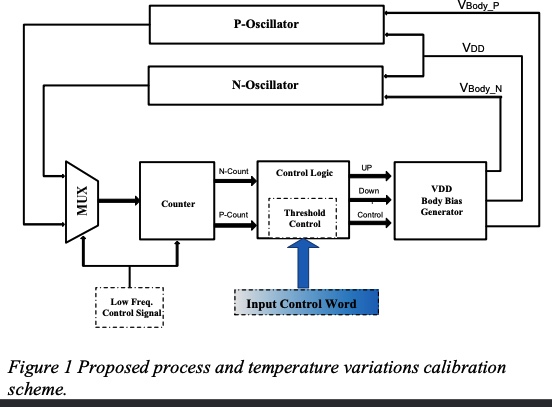
A dynamic power-aware process variation calibration scheme
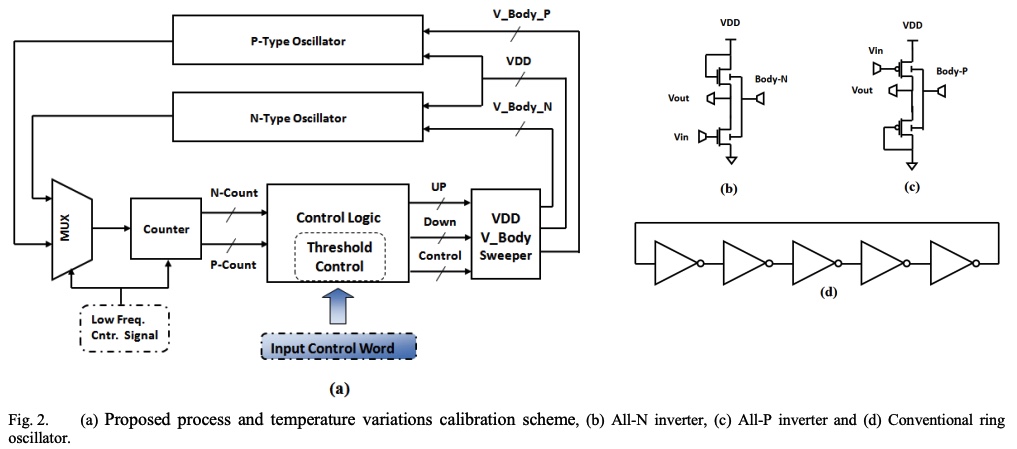
In this paper, a power-aware process variation calibration scheme is proposed. The proposed calibration system provides the ability to detect and control the n- and p-type variations independently through the use of all-n and all-p ring oscillators. Calibration is then carried out through the use of the supply voltage and body bias to alter the device parameters to match those of a certain process corner that is determined by the system designer. This scheme is characterized by its ability to dynamically change the desired mapping target according to the computational load. The calibration
A dynamic calibration scheme for on-chip process and temperature variations
A process and temperature variation calibration scheme is proposed in this paper. The proposed system uses the supply voltage and body bias to calibrate the device parameters to match those of a certain process corner that is determined by the system designer. This scheme is characterized by its ability to dynamically change the desired mapping target according to the computational load. Moreover, the proposed system provides the ability to detect and control the n- and p-type variations independently through the use of an all-n and all-p ring oscillators. The calibration system has been

Resonant square-wave clock generator for low power applications
Power reduction is the main challenge facing circuit designers in their quest to utilize the full performance of new process technologies. A major portion of the power consumed in today's systems is due to the clock generation and distribution. Resonant clocking has been a promising technique to reduce the clock power dramatically. In this paper, a novel resonant clock generator circuit is proposed to reduce the dynamic power used for clock generation by almost 75%. Two configurations of the circuit are presented. The merit of this generator is most obvious in the ease of its implementation