

Modified Blowfish Algorithm Based on Improved Lorenz Attractor
Image security becomes important topic because of increasing image usage in communication besides assures information security which is unseen in these images such as military and medical images. Blowfish is a superb symmetric cryptography that ensures a high degree of resistance to attacks. The proposed system modifies Blowfish algorithm by substituting the function in blowfish round with light weight function to save memory and resources of the platforms and Using 3-D chaotic system (Improved Lorenz) that work as a key timetable for creating Blowfish sub keys in order to increasing
A power-aware task scheduler for energy harvesting-based wearable biomedical systems using snake optimizer
There is an increasing interest in energy harvesting for wearable biomedical devices. This requires power conservation and management to ensure long-term and steady operation. Hence, task scheduling algorithms will be used throughout this work to provide a reliable solution to minimize energy consumption while considering the system operation constraints. This study proposes a novel power-aware task scheduler to manage system operations. For example, we used the scheduler to handle system operations, including heart rate and temperature sensors. Two optimization techniques have been used to

An Efficient DMO Task Scheduling Technique for Wearable Biomedical Devices
The popularity of wearable devices has grown as they improve the quality of life in many applications. In particular, for medical devices, energy harvesters are the dominating source of energy for wearable devices. However, their power budget is limited. Thus, power-saving techniques are essential components in the whole technology stack of those devices. That is, choosing the optimal schedule for different tasks running on the wearable device can help to reduce energy consumption. This paper presents a sensor task scheduling technique for optimizing energy consumption for energy harvesting
Improvement of piezoresistive pressure sensor using zig-zag shaped and PVDF material
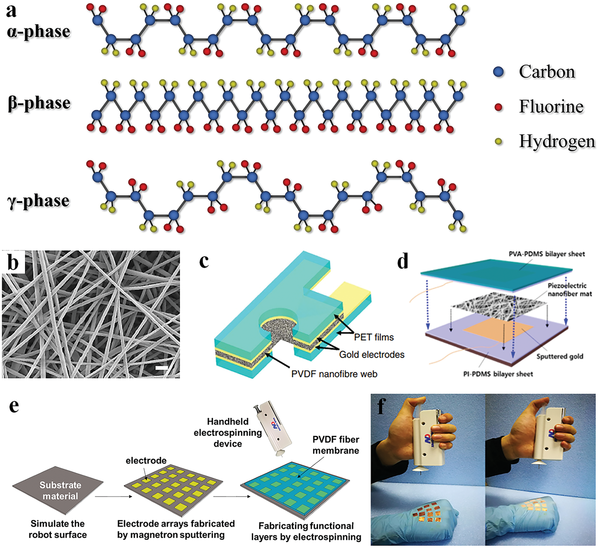
Due to a wide range of applications in the biomedical industry, the need for flexible and wearable sensors is growing every day. A pressure sensor generates a signal based on the applied pressure. Sensors have become an integral component of our daily lives, from personal gadgets to industrial machinery. The identification of the low signal from the body necessitates the use of particularly sensitive sensors. The development of a pressure sensor that can transform the maximum input signal into an electrical output is critical. In this paper, zig-zag piezoresistors on a square diaphragm were

Sustainable Energy-Aware Task Scheduling for Wearable Medical Device Using Flower Pollination Algorithm
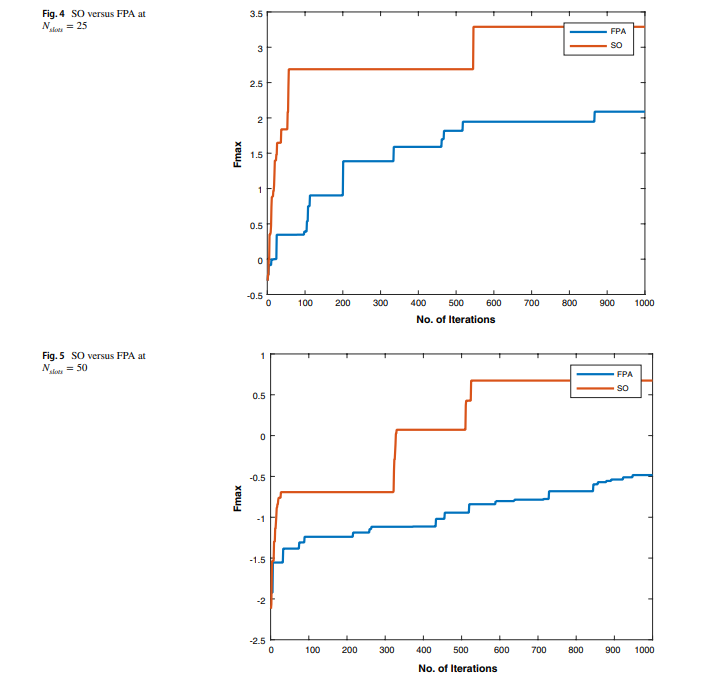
Power management and energy conservation are crucial for medical wearable devices that rely on energy harvesting. These devices operate under strict power budgets and require prolonged and stable operation. To achieve this, Energy-aware task scheduling is proposed as a solution to minimize energy consumption while ensuring the continued operational capabilities of the device. our paper presents a task scheduling method using the Flower Pollination Algorithm (FPA). The proposed task scheduling focuses on managing the activity of key components such as the heart rate sensor, temperature sensor
A Lightweight Image Encryption Scheme Using DNA Coding and Chaos
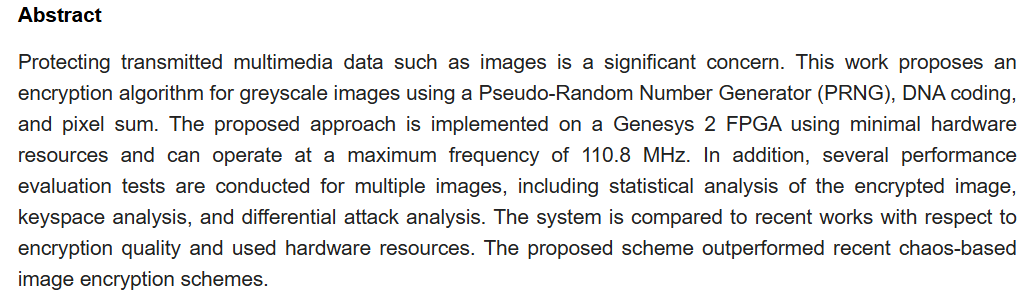
Protecting transmitted multimedia data such as images is a significant concern. This work proposes an encryption algorithm for greyscale images using a Pseudo-Random Number Generator (PRNG), DNA coding, and pixel sum. The proposed approach is implemented on a Genesys 2 FPGA using minimal hardware resources and can operate at a maximum frequency of 110.8 MHz. In addition, several performance evaluation tests are conducted for multiple images, including statistical analysis of the encrypted image, keyspace analysis, and differential attack analysis. The system is compared to recent works with
Realistic Wireless Smart-Meter Network Optimization Using Composite RPL Metric
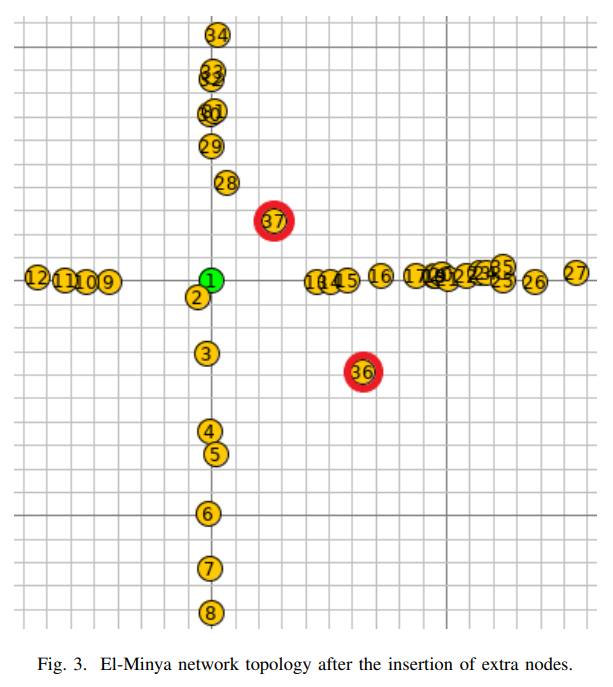
In smart metering applications, transferring and collecting data within delay constraints is crucial. IoT devices are usually resource-constrained and need reliable and energy-efficient routing protocol. Furthermore, meters deployed in lossy networks often lead to packet loss and congestion. In smart grid communication, low latency and low energy consumption are usually the main system targets. Considering these constraints, we propose an enhancement in RPL to ensure link reliability as well as low latency. We refer to the proposed new additive composite metric as Delay-Aware RPL (DA-RPL)

Semi-Fragile Watermark for the Authentication and Recovery of Tampered Images
In order to strengthen the safety of corporate multimedia assets, a semi-fragile watermarking method is developed, which makes use of the integer wavelet transform (IWT) and the discrete cosine transform (DCT) for tamper detection and recovery. In this paper, we produce two distinct kinds of watermarks: an authentication watermark and a recovery watermark. A tamper detection methodology is utilized at the receiving end to check the watermarked image for validity and detect any assaults. If the changes are determined to be malicious, the suggested tamper recovery method is used to restore the
Integration of Federated Machine Learning in Smart Metering Systems
The applications of Federated Learning are many, and they can be used to predict electricity consumption and, at the same time, enable smart meters to collaboratively learn a shared model while keeping all their data locally in their own private database. With this approach, the central model will see more data and will work better to predict electricity consumption more accurately than the models trained on only one local Dataset. The planning of infrastructure, grid operation, and budgeting all depend on accurate load forecasting. As a result, this paper suggests federated learning for load

SSHC with One Capacitor for Piezoelectric Energy Harvesting
Piezoelectric vibration energy harvesters have attracted a lot of attention as a way to power self-sustaining electronic systems. Furthermore, as part of the growing Internet of Things (loT) paradigm, the ongoing push for downsizing and higher degrees of integration continues to constitute major drivers for autonomous sensor systems. Two of the most effective interface circuits for piezoelectric energy harvesters are synchronised switch harvesting (SSH) on inductor and synchronous electrical charge extraction; nevertheless, inductors are essential components in both interfaces. This study