
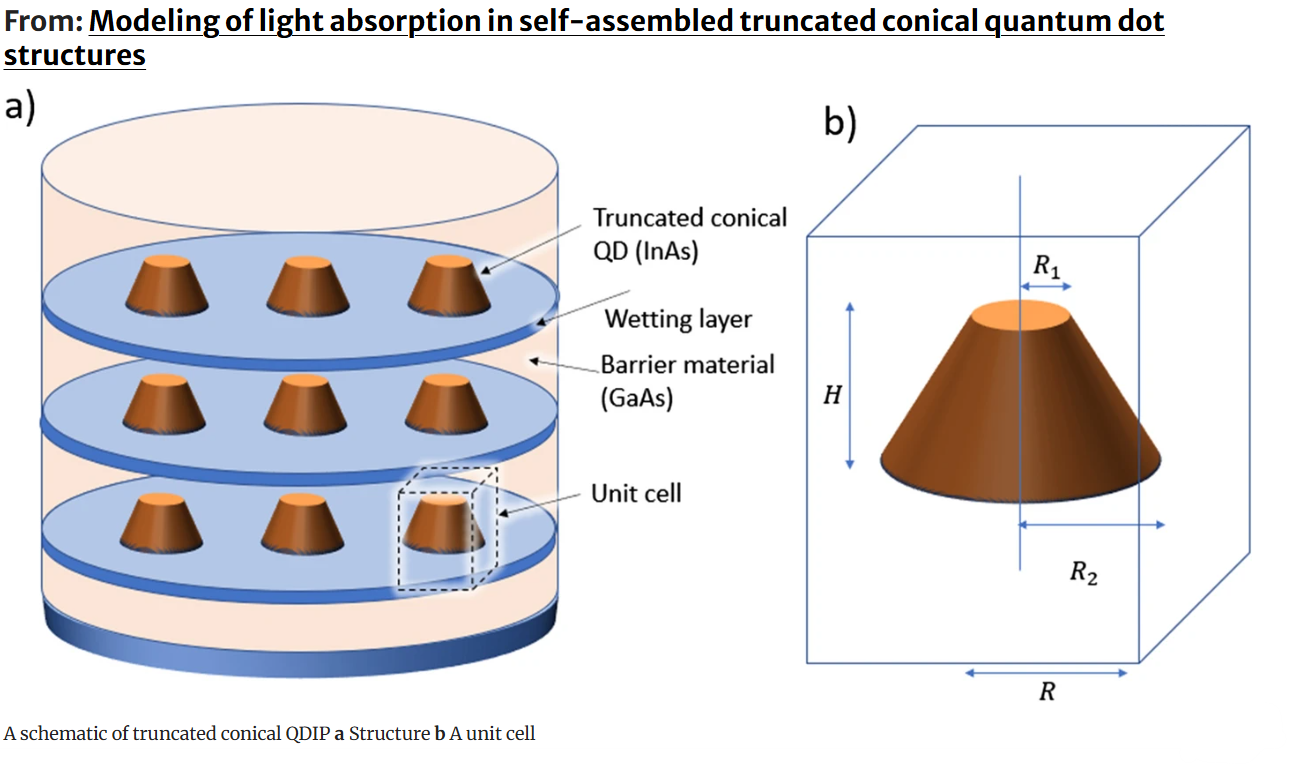
Modeling of light absorption in self-assembled truncated conical quantum dot structures
Quantum Dots have shown a significant potential as a top candidate for infrared photodetection at higher temperatures. In the presented work, a theoretical model for estimating the coefficient of optical absorption of self-assembled truncated conical quantum dot is developed. This model considers both bound-to-continuum and bound-to-bound absorption mechanisms that increase the accuracy of the absorption coefficient estimation. The developed model is based on estimating the bound states by diagonalizing the Hamiltonian matrix, where the density of states is computed using the Non-Equilibrium
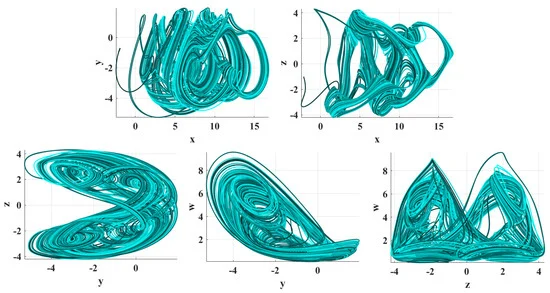
An Encryption Application and FPGA Realization of a Fractional Memristive Chaotic System
The work in this paper extends a memristive chaotic system with transcendental nonlinearities to the fractional-order domain. The extended system’s chaotic properties were validated through bifurcation analysis and spectral entropy. The presented system was employed in the substitution stage of an image encryption algorithm, including a generalized Arnold map for the permutation. The encryption scheme demonstrated its efficiency through statistical tests, key sensitivity analysis and resistance to brute force and differential attacks. The fractional-order memristive system includes a
Different Approximation Techniques For A FOPID Feedback Control of a DC Motor
DC motors are commonly employed in many industrial applications due to their various advantages. This study aims to compare the response of the Oustaloup-Recursive-Approximation (ORA) and El-Khazali's approximation method in controlling a DC motor with a FOPID controller. The two employed methods are used to design the FOPID and approximate. For various fractional orders, many behaviours are presented. A simulation comparison between these methods is performed regarding overshoot, settling time and rise time. © 2022 IEEE.
Enhancing the Performance of Thin Film Photovoltaic Solar Cells using Truncated Conical Nanoparticles
Plasmonic photovoltaics are considered as promising photovoltaic candidate with enhanced optical absorption and quantum efficiency by embedding metallic nanoparticles in the photovoltaic active layer. In this paper, the efficiency enhancement of ultra-thin film solar cells with embedded truncated cone nanoparticles is studied. First, the natural electric field modes of the truncated cone in free-space are examined when excited by a plane wave. Parametric study is then performed to investigate the effects of the geometrical parameters of the structure on its resonant modes. Second, a uniform

Energy Harvesting Management Unit for Wearable Devices
Energy harvesting materials and systems have become a popular study topic that is rapidly expanding. The harvesters will be used for a variety of applications, including distributed wireless sensor nodes for structural health monitoring, embedded and implanted sensor nodes for medical applications, recharging large system batteries, monitoring pressure in automobiles, powering unmanned vehicles, and running security systems in domestic settings. Components and devices at micro-macro sizes, spanning materials, electronics, and integration, have recently been developed. Energy harvesting has
Fractional-Order Design: Devices, Circuits, and Systems: Volume 3 in Emerging Methodologies and Applications in Modelling
Fractional-Order Design: Devices, Circuits, and Systems introduces applications from the design perspective so that the reader can learn about, and get ready to, design these applications. The book also includes the different techniques employed to comprehensively and straightforwardly design fractional-order systems/devices. Furthermore, a lot of mathematics is available in the literature for solving the fractional-order calculus for system application. However, a small portion is employed in the design of fractional-order systems. This book introduces the mathematics that has been employed
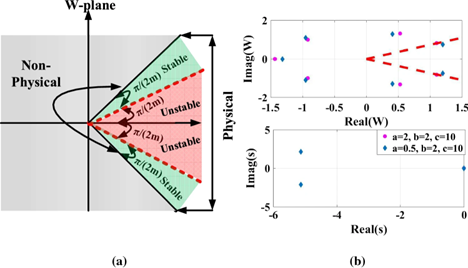
Correction to: Stability analysis of fractional-order Colpitts oscillators (Analog Integrated Circuits and Signal Processing, (2019), 101, 2, (267-279), 10.1007/s10470-019-01501-2)
Unfortunately, in the original version of the article some typos occurred. The typos have been corrected with this erratum. Below are the corrections:(Formula presented.). © 2019, Springer Science+Business Media, LLC, part of Springer Nature.
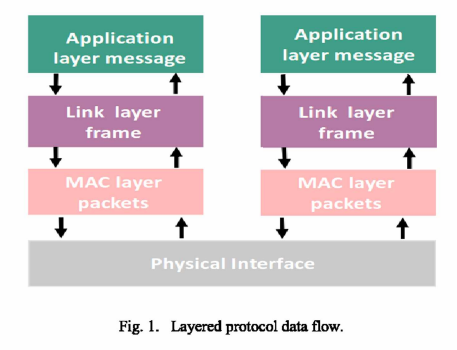
An Automated Lightweight UVM Tool
In this paper, an automated universal verification methodology (UVM) tool for rapid functional verification is presented. Now, UVM dominates the verification process but, it is very hard and too complicated to learn. This paper introduces a lightweight UVM tool which allows the user to rapidly verify complex RTL designs and different IPs. Also, it allows the user to perform the simulation for any design under test (DUT). The proposed tool generates the suitable UVM architecture to the DUT with the needed codes. Moreover, it provides the user with statistics about the number of the used classes
Bowtie-Shaped Plasmonic Nanoparticles-Enhanced Photovoltaic Anti-Reflective Coating
Light trapping is a promising technique that enhances sunlight absorption by solar cells. This paper presents a study of bow-tie-shaped nanoparticles embedded in the antireflection coating of photovoltaic solar cells, which enhances the optical transmission of the photovoltaic surface. Therefore, the optical path length for light penetration is increased through the semiconductor active layer. First, the fundamental electric field modes of a single nanoscaled bow-tie are examined under excitation of plane waves with different polarizations. Second, an array of bow-tie-shaped nanoparticles is
FPGA REALIZATION OF COMPLEX LOGISTIC MAP FRACTAL BEHAVIOR
This paper studies the capability of digital architecture to mimic fractal behavior. As chaotic attractors realized digitally had opened many tracks, digital designs mimicking fractals may ultimately achieve the same. This study is based on a complex single-dimensional discrete chaotic system known as the generalized positive logistic map. The fractals realized from this system are linked to the results of the mathematical analysis to understand the fractal behavior with different variations. A digital hardware architecture manifesting the fractal behavior is achieved on FPGA, showing a