

A Robust Deep Learning Detection Approach for Retinopathy of Prematurity
Retinal retinopathy of prematurity (ROP), an abnormal blood vessel formation, can occur in a baby who was born early or with a low birth weight. It is one of the primary causes of newborn blindness globally. Early detection of ROP is critical for slowing and stopping the progression of ROP-related vision impairment which leads to blindness. ROP is a relatively unknown condition, even among medical professionals. Due to this, the dataset for ROP is infrequently accessible and typically extremely unbalanced in terms of the ratio of negative to positive images and the ratio of each stage of it
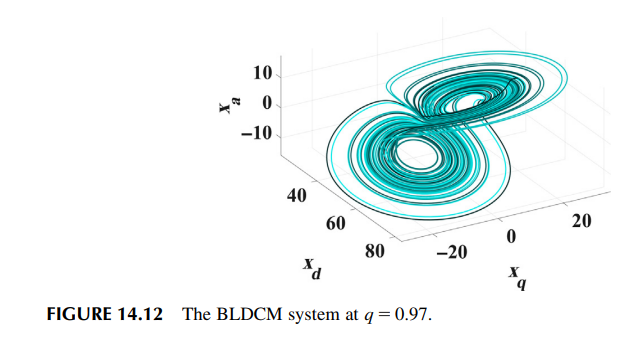
Applications of continuous-time fractional order chaotic systems
The study of nonlinear systems and chaos is of great importance to science and engineering mainly because real systems are inherently nonlinear and linearization is only valid near the operating point. The interest in chaos was increased when Lorenz accidentally discovered the sensitivity to initial condition during his simulation work on weather prediction. When a nonlinear system is exhibiting deterministic chaos, it is very difficult to predict its response under external disturbances. This behavior is a double-edged weapon. From a control and synchronization point of view, this proposes a
Capacitive Power Transfer Modeling of Charging Inner-body Devices
Wireless power transfer (WPT) is highly desirable for applications with battery restrictions, such as biomedical applications. For example, in the case of implantable devices, power is transmitted through the human body, which has dielectric characteristics that must be considered during the design of the WPT system. This paper examines capacitive power transfer through the human body and formulates the complete WPT system, including the human body model. The power delivered to the implantable device is also analyzed. Finally, the system efficiency is discussed under different body and load
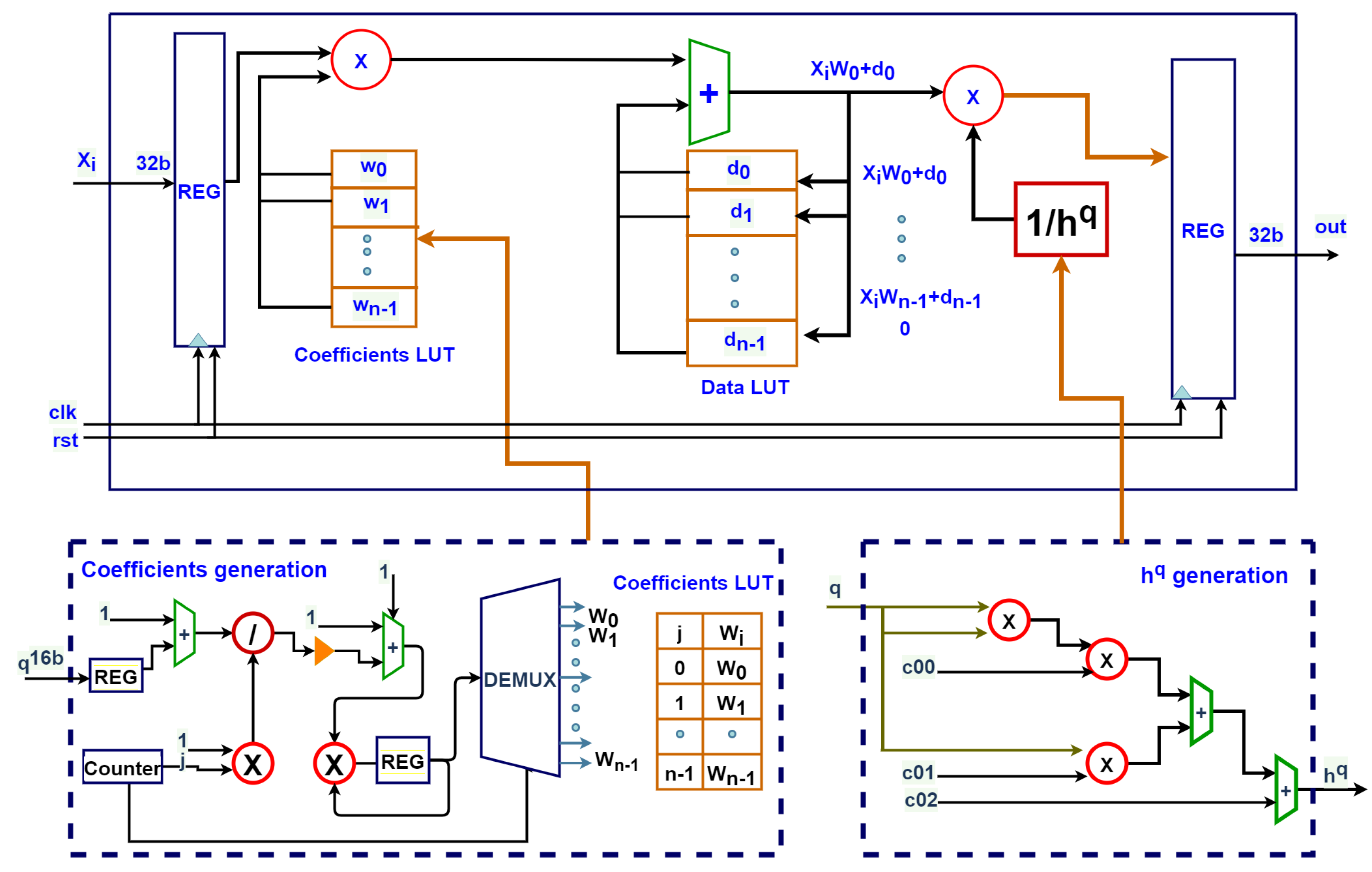
A Unified FPGA Realization for Fractional-Order Integrator and Differentiator
This paper proposes a generic FPGA realization of an IP core for fractional-order integration and differentiation based on the Grünwald–Letnikov approximation. All fractional-order dependent terms are approximated to simpler relations using curve fitting to enable an efficient hardware realization. Compared to previous works, the proposed design introduces enhancements in the fractional-order range covering both integration and differentiation. An error analysis between software and hardware results is presented for sine, triangle and sawtooth signals. The proposed generic design is realized
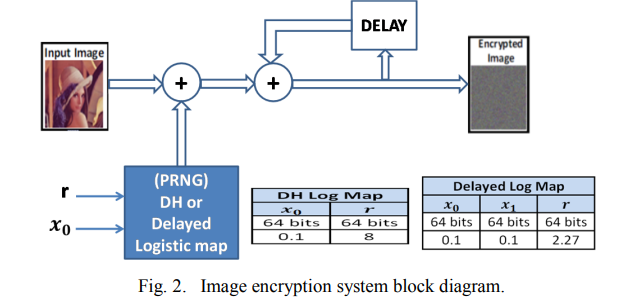
Image encryption based on double-humped and delayed logistic maps for biomedical applications
This paper presents a secured highly sensitive image encryption system suitable for biomedical applications. The pseudo random number generator of the presented system is based on two discrete logistic maps. The employed maps are: the one dimensional double humped logistic map as well as the two-dimensional delayed logistic map. Different analyses are introduced to measure the performance of the proposed encryption system such as: histogram analysis, correlation coefficients, MAE, NPCR as well as UACI measurements. The encryption system is proven to be highly sensitive to ±0.001% perturbation
COVID-19 Diagnosis from CT-images Using Transfer Learning
In symptomatic patients, a positive COVID-19 test is critical for securing life-saving services such as ICU care and ventilator support; it may cause septic shock, septic pneumonia, respiratory failure, heart difficulties, liver issues, and even death. CAD systems help people in rural places and doctors in the early detection of COVID-19. A diagnostic and severity detection technique utilizing transfer learning and a backpropagation neural network has been developed with the aid of a computer for this purpose. This study aims to compare and analyze multiple deep learning-enhanced strategies

Commercial Versus Natural Activated Carbon Fabricated Sheets: Applied to Dyes Removal Application
Industrial dyes are considered one of the main causes of increased water pollution of water. Many businesses, such as steel and paper, are located along riverbanks because they require large amounts of water in their manufacturing processes, and their wastes, which contain acids, alkalis, dyes, and other chemicals, are dumped and poured into rivers as effluents. For example, chemical enterprises producing aluminum emit a significant quantity of fluoride into the air and effluents into water bodies. Fertilizer facilities produce a lot of ammonia, whereas steel plants produce cyanide. Many
Enhanced removal of crystal violet using rawfava bean peels, its chemically activated carbon compared with commercial activated carbon
Crystal violet is a basic dye that is widely used by various industries, such as textiles and paints. These industries discharge their effluents, contaminated with crystal violet, into water streams, and these effluents have an adverse effect on aquatic organisms, the environment, and human health. Crystal violet is a basic dye that is widely used by various industries, such as textiles and paints. These industries discharge their effluents, contaminated with crystal violet, into water streams, and these effluents have an adverse effect on aquatic organisms, the environment, and human health
Bio-inspired adsorption sheets from waste material for anionic methyl orange dye removal
Abstract: Nano zero-valent iron (nZVI), bimetallic nano zero-valent iron-copper (Fe0–Cu), and Raw algae (sargassum dentifolium) activated carbon-supported bimetallic nano zero-valent iron-copper (AC-Fe0–Cu) are synthesized and characterized using FT-IR, XRD, and SEM. The maximum removal capacity is demonstrated by bimetallic activated carbon AC-Fe0–Cu, which is estimated at 946.5 mg/g capacity at the condition pH = 7, 30 min contact time under shaking at 120 rpm at ambient temperature, 200 ppm of M.O, and 1 g/l dose of raw algae-Fe0–Cu adsorbent. The elimination capability of the H3PO4
Experimental investigation of methyl-orange removal using eco-friendly cost-effective materials raw fava bean peels and their formulated physical, and chemically activated carbon
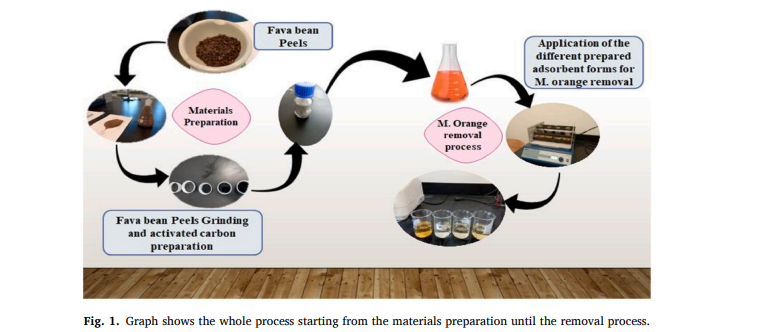
The discharge of effluents from dye industries into water streams poses a significant environmental and public health risk. In response, eco-friendly adsorbents derived from agricultural waste, such as Fava Bean Peels (R–FBP), have been investigated as potential materials for the removal of such pollutants. In this study, R–FBP and their corresponding physical and chemically activated carbon (P-RFB-AC and C-FBP-AC) were synthesized using H3PO4 acid and characterized using FT-IR, and SEM analyses. An optimization process was conducted to determine the optimum conditions for achieving high